


Page 119 - Demo
P. 119
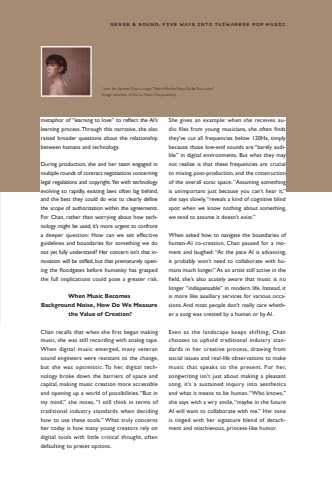
Cover for Sandee Chan%u2019s single \(Image courtesy of Da Le Music Corporation)Sense & Sound: Five Ways into Taiwanese Pop Musicmetaphor of %u201clearning to love%u201d to reflect the AI%u2019s learning process. Through this narrative, she also raised broader questions about the relationship between humans and technology.During production, she and her team engaged in multiple rounds of contract negotiations concerning legal regulations and copyright. Yet with technology evolving so rapidly, existing laws often lag behind, and the best they could do was to clearly define the scope of authorization within the agreements. For Chan, rather than worrying about how technology might be used, it%u2019s more urgent to confront a deeper question: How can we set effective guidelines and boundaries for something we do not yet fully understand? Her concern isn%u2019t that innovation will be stifled, but that prematurely opening the floodgates before humanity has grasped the full implications could pose a greater risk.When Music Becomes Background Noise, How Do We Measure the Value of Creation?Chan recalls that when she first began making music, she was still recording with analog tape. When digital music emerged, many veteran sound engineers were resistant to the change, but she was optimistic. To her, digital technology broke down the barriers of space and capital, making music creation more accessible and opening up a world of possibilities. %u201cBut in my mind,%u201d she notes, %u201cI still think in terms of traditional industry standards when deciding how to use these tools.%u201d What truly concerns her today is how many young creators rely on digital tools with little critical thought, often defaulting to preset options.She gives an example: when she receives audio files from young musicians, she often finds they%u2019ve cut all frequencies below 120Hz, simply because those low-end sounds are %u201cbarely audible%u201d in digital environments. But what they may not realize is that these frequencies are crucial to mixing, post-production, and the construction of the overall sonic space. %u201cAssuming something is unimportant just because you can%u2019t hear it,%u201d she says slowly, %u201creveals a kind of cognitive blind spot: when we know nothing about something, we tend to assume it doesn%u2019t exist.%u201dWhen asked how to navigate the boundaries of human-AI co-creation, Chan paused for a moment and laughed: %u201cAt the pace AI is advancing, it probably won%u2019t need to collaborate with humans much longer.%u201d As an artist still active in the field, she%u2019s also acutely aware that music is no longer %u201cindispensable%u201d in modern life. Instead, it is more like auxiliary services for various occasions. And most people don%u2019t really care whether a song was created by a human or by AI.Even as the landscape keeps shifting, Chan chooses to uphold traditional industry standards in her creative process, drawing from social issues and real-life observations to make music that speaks to the present. For her, songwriting isn%u2019t just about making a pleasant song, it%u2019s a sustained inquiry into aesthetics and what it means to be human. %u201cWho knows,%u201d she says with a wry smile, %u201cmaybe in the future AI will want to collaborate with me.%u201d Her tone is tinged with her signature blend of detachment and mischievous, princess-like humor.


