


Page 132 - Demo
P. 132
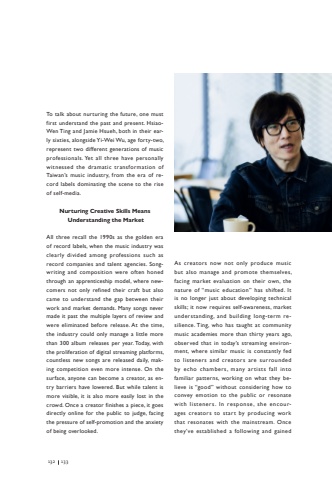
To talk about nurturing the future, one must first understand the past and present. HsiaoWen Ting and Jamie Hsueh, both in their early sixties, alongside Yi-Wei Wu, age forty-two, represent two different generations of music professionals. Yet all three have personally witnessed the dramatic transformation of Taiwan%u2019s music industry, from the era of record labels dominating the scene to the rise of self-media.Nurturing Creative Skills Means Understanding the MarketAll three recall the 1990s as the golden era of record labels, when the music industry was clearly divided among professions such as record companies and talent agencies. Songwriting and composition were often honed through an apprenticeship model, where newcomers not only refined their craft but also came to understand the gap between their work and market demands. Many songs never made it past the multiple layers of review and were eliminated before release. At the time, the industry could only manage a little more than 300 album releases per year. Today, with the proliferation of digital streaming platforms, countless new songs are released daily, making competition even more intense. On the surface, anyone can become a creator, as entry barriers have lowered. But while talent is more visible, it is also more easily lost in the crowd. Once a creator finishes a piece, it goes directly online for the public to judge, facing the pressure of self-promotion and the anxiety of being overlooked.As creators now not only produce music but also manage and promote themselves, facing market evaluation on their own, the nature of %u201cmusic education%u201d has shifted. It is no longer just about developing technical skills; it now requires self-awareness, market understanding, and building long-term resilience. Ting, who has taught at community music academies more than thirty years ago, observed that in today%u2019s streaming environment, where similar music is constantly fed to listeners and creators are surrounded by echo chambers, many artists fall into familiar patterns, working on what they believe is %u201cgood%u201d without considering how to convey emotion to the public or resonate with listeners. In response, she encourages creators to start by producing work that resonates with the mainstream. Once they%u2019ve established a following and gained 132133


