


Page 57 - Demo
P. 57
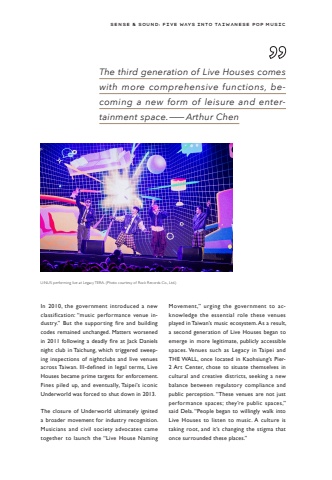
Sense & Sound: Five Ways into Taiwanese Pop MusicThe third generation of Live Houses comes with more comprehensive functions, becoming a new form of leisure and entertainment space.%u2014Arthur ChenIn 2010, the government introduced a new classification: %u201cmusic performance venue industry.%u201d But the supporting fire and building codes remained unchanged. Matters worsened in 2011 following a deadly fire at Jack Daniels night club in Taichung, which triggered sweeping inspections of nightclubs and live venues across Taiwan. Ill-defined in legal terms, Live Houses became prime targets for enforcement. Fines piled up, and eventually, Taipei%u2019s iconic Underworld was forced to shut down in 2013.The closure of Underworld ultimately ignited a broader movement for industry recognition. Musicians and civil society advocates came together to launch the %u201cLive House Naming Movement,%u201d urging the government to acknowledge the essential role these venues played in Taiwan%u2019s music ecosystem. As a result, a second generation of Live Houses began to emerge in more legitimate, publicly accessible spaces. Venues such as Legacy in Taipei and THE WALL, once located in Kaohsiung%u2019s Pier2 Art Center, chose to situate themselves in cultural and creative districts, seeking a new balance between regulatory compliance and public perception. %u201cThese venues are not just performance spaces; they%u2019re public spaces,%u201d said Dela. %u201cPeople began to willingly walk into Live Houses to listen to music. A culture is taking root, and it%u2019s changing the stigma that once surrounded these places.%u201dU:NUS performing live at Legacy TERA. (Photo courtesy of Rock Records Co., Ltd.)


