


Page 55 - Demo
P. 55
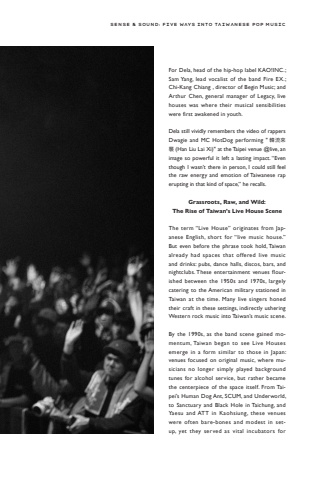
Sense & Sound: Five Ways into Taiwanese Pop MusicFor Dela, head of the hip-hop label KAO!INC.; Sam Yang, lead vocalist of the band Fire EX.; Chi-Kang Chiang , director of Begin Music; and Arthur Chen, general manager of Legacy, live houses was where their musical sensibilities were first awakened in youth.Dela still vividly remembers the video of rappers Dwagie and MC HotDog performing \%u8972 (Han Liu Lai Xi)\image so powerful it left a lasting impact. %u201cEven though I wasn%u2019t there in person, I could still feel the raw energy and emotion of Taiwanese rap erupting in that kind of space,%u201d he recalls.Grassroots, Raw, and Wild: The Rise of Taiwan%u2019s Live House SceneThe term %u201cLive House%u201d originates from Japanese English, short for %u201clive music house.%u201d But even before the phrase took hold, Taiwan already had spaces that offered live music and drinks: pubs, dance halls, discos, bars, and nightclubs. These entertainment venues flourished between the 1950s and 1970s, largely catering to the American military stationed in Taiwan at the time. Many live singers honed their craft in these settings, indirectly ushering Western rock music into Taiwan%u2019s music scene.By the 1990s, as the band scene gained momentum, Taiwan began to see Live Houses emerge in a form similar to those in Japan: venues focused on original music, where musicians no longer simply played background tunes for alcohol service, but rather became the centerpiece of the space itself. From Taipei%u2019s Human Dog Ant, SCUM, and Underworld, to Sanctuary and Black Hole in Taichung, and Yaesu and ATT in Kaohsiung, these venues were often bare-bones and modest in setup, yet they served as vital incubators for


